Power-Law Payouts: One Exponent Shapes the Table
Power-law payouts: one exponent, the whole shape
The big idea in one sentence: a power-law payout gives each finisher a slice proportional to 1 over their position raised to a power — so the top spots take dramatic jumps, the bottom spots barely differ, and a single exponent decides how top-heavy the whole thing is.
If you've ever looked at a big tournament's payout sheet and wondered why first pays a fortune, the top ten step down in real chunks, and everyone from 30th to 90th cashes for roughly the same handshake — that shape has a name. It's a power law, and once you see the one number behind it, you can read any payout table on sight.
First, what a payout structure is not
A payout structure doesn't decide how much money is in the room. The field does that.
The prize pool comes from the buy-ins — entrants × buy-in, minus rake. Ninety players at $100 with no rake is a $9,000 pool, full stop. Power-law payouts don't touch that figure. They answer the next question, and only that one: how do we split the $9,000 among the people who cashed?
Same division of labor as geometric payouts: the pool is sized by the field, and the formula only shapes the distribution. Points reward how hard your finish was across a season; payouts divide tonight's money. Different jobs, different math.
The formula
Payout_n ∝ 1 ÷ n^k
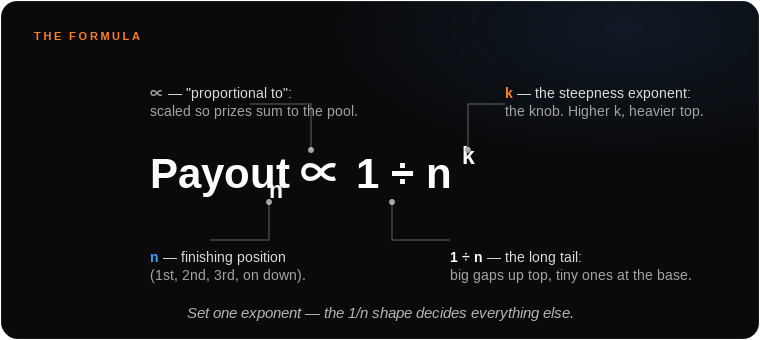
Three parts, and only one of them is a decision.
n → the finishing position. 1st, 2nd, 3rd, on down. Where you came in, not something you set.
k → the steepness exponent. This is the knob. Turn it up and the winner swallows more of the pool; turn it down and the money spreads across more places. Real tables live between about 0.7 and 1.5. One number sets the entire slope of the table.
∝ ("proportional to") → the scaling. The raw 1/n^k values don't add up to your pool on their own, so you scale every prize by the same factor until they sum to exactly the money in the room. That's the one bit of setup: compute the shares, then stretch them to fit the pool.
Set one exponent. The 1/n shape decides everything else.
Why this shape? The 1/n intuition
The heart of it is that plain 1/n term — one over your finishing position — and it's worth sitting with, because it's the whole personality of the curve.
At k = 1, the shape is pure 1/n: first place gets the base figure, and every other spot is simply that figure divided by its finishing position. Second gets a half, third gets a third, tenth gets a tenth. It's the most napkin-friendly payout there is.
Take the same $9,000 pool, pay the final table of 9, and set k = 1. Scale first place so the column sums to the pool — about $3,181 — then just divide down:
| Place | Prize | How it's built |
|---|---|---|
| 1st | $3,181 | Payout_1 |
| 2nd | $1,591 | ÷ 2 |
| 3rd | $1,060 | ÷ 3 |
| 4th | $795 | ÷ 4 |
| 5th | $636 | ÷ 5 |
| 6th | $530 | ÷ 6 |
| 7th | $454 | ÷ 7 |
| 8th | $398 | ÷ 8 |
| 9th | $353 | ÷ 9 |
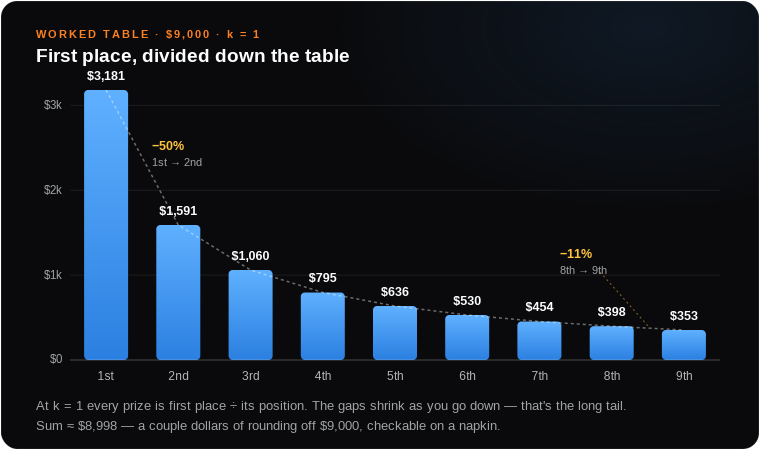
Add them up: $8,998, two dollars of rounding off $9,000. And here's the tell — you can check the whole table on a napkin. There's no chart to look up. If a player wants to know why 6th pays $530, the answer is one division they can redo themselves: first place over six.
Notice the bottom line, too. 9th min-cashes for $353 on a $100 buy-in — three and a half times your money back, not the bus fare a steep curve would hand you. That's the long tail being generous: near the bubble, power-law is kind.
The move that defines it: the drop shrinks as you go down
This is the part that separates power-law from every other payout family, so slow down here.
Under the 1/n shape, the gap between neighbors collapses as you descend. First to second is a 50% cliff — half the prize gone in one place. Eighth to ninth is barely an 11% step. The curve is nearly vertical at the top and nearly flat at the bottom.
Compare that to a geometric payout, where every rung is the same proportional drop — a constant 35% at r = 0.65, top to bottom, no matter where you stand. That's the clean contrast between the two:
Geometric drops the same at every place. Power-law drops hard at the top and barely at the bottom.
Which is exactly why the two feel so different at the table. Geometric is even-handed; power-law is dramatic where drama sells — up top — and quietly egalitarian where it doesn't matter much — down in the min-cashes. That long flat tail isn't an accident. It's the shape doing its job.
One knob, three very different tables
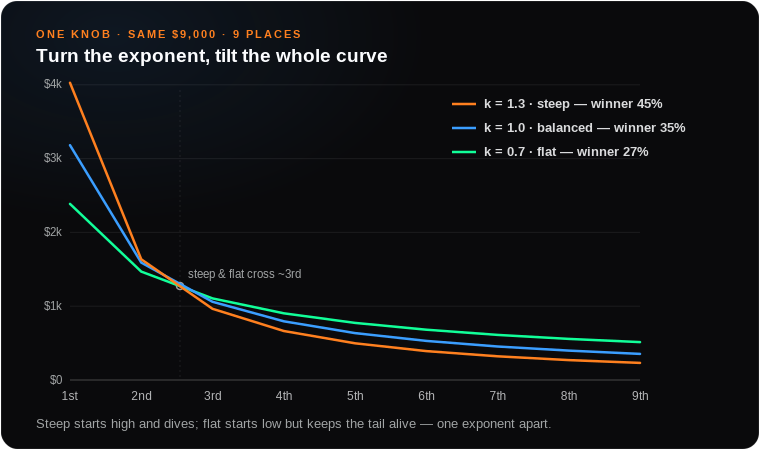
Now the part that earns the exponent its keep. Keep the same $9,000 and the same 9 spots, and change only k:
| Flat (k = 0.7) | Balanced (k = 1.0) | Steep (k = 1.3) | |
|---|---|---|---|
| 1st place | $2,386 | $3,181 | $4,026 |
| 1st's share of pool | 27% | 35% | 45% |
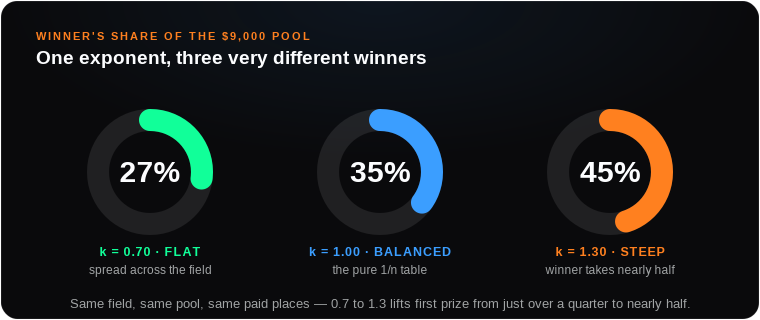
Same field, same pool, same paid places. Move one number from 0.7 to 1.3 and first prize climbs from just over a quarter of the pool to nearly half. You're not rewriting nine numbers to make the top heavier — you're nudging a single exponent and watching the whole curve tilt.
If those endpoints look familiar, they should: a geometric table swept across its own knob lands in almost the same range. Two different equations, two different knobs, converging on the same set of shapes — because they're both chasing the same thing, a curve that pays for finishing higher. That's the throughline across the whole payout family.
Why big tournaments are built on power-law payouts
Power-law naturally produces the exact shape a large-field event wants:
- A headline first prize that feels like a headline — the steep top of the curve does that for free.
- Meaningful jumps through the top ten, where every ladder rung climbed is real money, so the final-table bubble bites.
- A long, flat tail where dozens of players still take home a respectable min-cash instead of cab fare.
Reverse-engineer the payout tables the big series actually publish and most of them come out as a power law with k somewhere around 0.7 to 1.0 — a touch flatter than you'd guess, because a flatter tail cashes more players and keeps the room happy. On top of the raw curve they bolt two practical adjustments: a min-cash floor so the bottom prize never dips below, say, 1.5× the buy-in, and a cap on the winner's share so a high exponent can't hand one player the building. Clean skeleton, a little practical muscle — and it's the de facto foundation of large-field payout design.
What this rewards, and what it doesn't
What it rewards: the top, and the marketing of the top. Power-law puts the money where the story is. It makes finishing 1st instead of 2nd feel enormous, which is exactly the incentive a big event is selling. And it scales to any field — 9 players or 900, you compute the same shares and stretch them to the pool.
What it doesn't do on its own: protect the bottom, or restrain the top. Pure power-law with no floor can leave a min-cash barely above the buy-in, and with a high k and no cap it hands the winner an uncomfortable share of the room. That's not a flaw in the math; it's the honest consequence of a curve that's built to be top-heavy. The floor and the cap aren't fixes to a broken model — they're the guardrails you add once you've picked a shape that leans.
FAQ
What's a normal value for k?
For most published tournament tables, roughly 0.7 to 1.0. Below that the curve is very flat (everyone cashes for something similar); above ~1.2 it gets aggressively top-heavy. Higher k always means a bigger slice for the winner and a steeper drop through the top spots.
How is a power-law payout different from a geometric one? The drop. A geometric payout falls by the same percentage at every place — a constant step, top to bottom. A power-law payout falls hard between the top spots and barely at all near the bubble. Same goal, different curve: geometric is even, power-law is dramatic up top and flat at the tail.
Why do the top prizes jump so much more than the bottom ones? Because of the 1/n shape. The difference between 1/1 and 1/2 is huge (a 50% drop); the difference between 1/8 and 1/9 is tiny (about 11%). The gaps shrink automatically as the positions climb, which is the long-tail feel every big tournament is after.
Does adding a paid place change first prize? Yes. Pay a 10th spot and there's one more slice to cut from the same pool, so every prize — first included — renormalizes down a little to keep the total at the pool. The exponent stays put; only the scaling shifts.
Do real tournaments use pure power-law?
Mostly the shape, rarely the raw formula. Reverse-engineered, the big tables track a power law with k near 0.7–1.0, then add a min-cash floor at the bottom and a cap on the winner's share at the top. The power law is the spine; the floor and cap are the practical trim.
Key takeaways
- Power-law payouts split the pool; they don't size it — the field and the rake set the pool.
- The whole table comes from one exponent
kand the 1/n shape:Payout_n ∝ 1 ÷ n^k. kis the knob. Low = flat and forgiving; high = top-heavy. One number tilts the entire curve.- The signature move is a shrinking drop — huge gaps up top, tiny gaps at the bottom — which is the opposite of geometric's constant step.
- It's the de facto shape of big-field tournaments, usually with
k ≈ 0.7–1.0plus a min-cash floor and a winner-share cap.
None of this is hard math — it's one exponent and a column you can divide in your head. But doing it live — solving the scale, holding the floor, redrawing the table the moment a re-entry changes the field — is the kind of bookkeeping that turns a fun night into a second job. The point isn't the software; it's that once the split is automatic, you get to pick the exact shape your room wants — a headline first prize, a generous tail, or anything between — and hand out prizes every player can check for themselves.
One exponent in, the whole table out. That's a payout curve you can defend at the final table.
Pitbosser is poker tournament software for clubs and home leagues. The clock, the knockouts, the standings — handled.