Geometric vs Power-Law Payouts: Which One, When?
Geometric vs power-law payouts: which shape, and when
It's past midnight and the host — call him Dave — is dividing a shoebox of cash on the back of a used scorecard. Nine players paid, a $900 pool, the tenth-place bust-out still pulling on his jacket by the door. Dave writes first prize at the top, then works down the column: each place gets a little under two-thirds of the one above it, the pen slowing as the numbers shrink, until ninth place is basically cab fare. He has never heard the phrase geometric payout. He's been paying one for years.
Six hundred miles away, at the same hour, someone limps into the money in a 1,200-runner Sunday online, sees a min-cash land in their balance, and closes the tab. They've just been paid by a completely different curve — a power law — and they never saw a lick of the arithmetic.
"All you need is a chip and a chair." That's Jack Straus's line, after he ground back from a single chip to win the 1982 Main Event, and it's the romance the whole format runs on: you're never dead until you're actually dead. But whether the short stack near the b ottom is grinding toward anything real — whether the tail pays at all — isn't romance. It's a decision someone made with the shape of the curve. Dave made it on a napkin. The online room made it with an engine.
The big idea in one sentence: geometric and power-law payouts are the two clean ways to slice a prize pool — geometric drops by the same percentage at every place, power-law drops hard at the top and barely at the bottom — and which one a room should use comes down to a single question: how many places are you paying?
Same job, both of them. Divide the money. Dave's napkin and the online room's payout engine are solving the identical problem and reaching for opposite shapes, and neither is doing it by accident. This is the piece that tells you which is which, why the kitchen table and the WSOP landed on different answers, and how the shape you're sitting in should quietly change the way you play.
The two shapes, in one breath each
Both are covered in full elsewhere — geometric payouts and power-law payouts — so here's just enough to put them side by side.
- Geometric: each place pays a fixed ratio
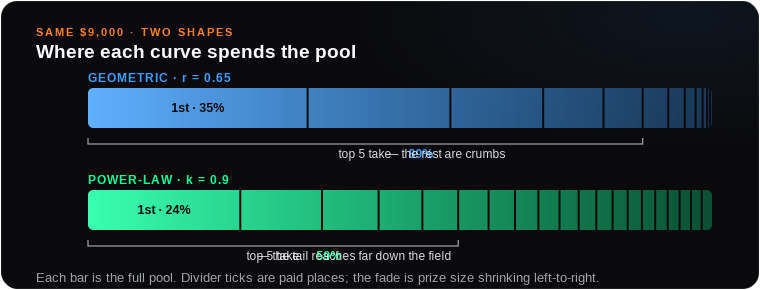
rof the place above it. Atr = 0.65, every prize is 65% of the one before — a constant proportional drop, the same step on every rung, top to bottom. That's Dave's napkin: two-thirds down, two-thirds down, two-thirds down. - Power-law: each place pays proportional to
1 ÷ n^k, wherenis your finish andkis the steepness knob. The gaps shrink as you go down — a 50% cliff between 1st and 2nd, an 11% nudge between 8th and 9th.
One drops the same everywhere. The other is dramatic up top and flat at the tail. That difference sounds cosmetic. It isn't — and the reason is the whole article.
The one question that decides it: how many places do you pay?
Here's the thing nobody tells you: at a single final table, the two shapes are near-twins. Dave's nine spots from a $9,000 pool — the two curves barely diverge:
| Place | Geometric (r = 0.65) | Power-law (k = 0.9) |
|---|---|---|
| 1st | 36% | 32% |
| 5th | 6% | 8% |
| 9th | 1% | 5% |
Close enough that nobody at Dave's table would feel cheated by either. So if the argument stopped at nine places, you'd flip a coin — and the napkin wins, because it's a napkin.
It doesn't stop at nine. Watch what happens when you try to pay a big field.
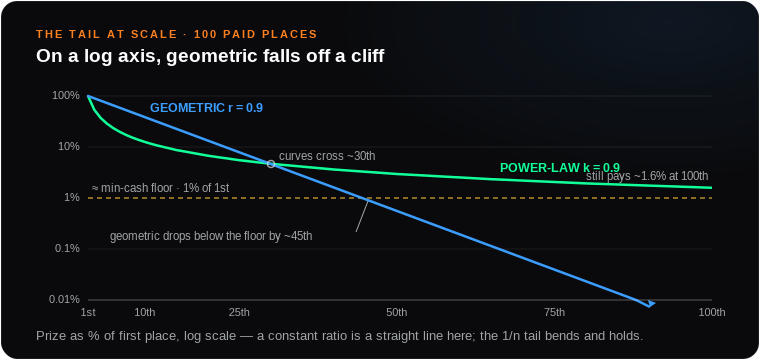
A geometric curve has a fatal habit: because it drops by the same percentage forever, the tail collapses toward zero fast. Keep a lively top with r = 0.65 and the prize falls below 1% of first place by 14th — there's simply nothing left to pay a 15th, let alone a 150th. You can flatten it to r = 0.9 to reach deeper, but now second place is 90% of first — barely a pay jump, a boring top — and it still dies below 1% by 45th. Geometric makes you choose: a lively top, or a long tail. You can't have both.
Power-law hands you both for free. Look at the same last-place-vs-first-place ratio as the field grows:
| Paid place | Geometric r = 0.9 | Power-law k = 0.9 |
|---|---|---|
| 10th | 39% | 13% |
| 50th | 0.6% | 3.0% |
| 100th | 0.003% | 1.6% |
By 100th place the geometric prize is three-thousandths of a percent of the top — it has vanished — while the power-law prize is a real 1.6% of first, a payable min-cash. And notice the top: power-law's second place is still 54% of first, a genuine jump. That's the whole case in one table. Geometric can't afford a long tail. Power-law is built for one.
Few paid places → either shape works. Many paid places → only power-law survives.
So who uses which, and why it isn't an accident
Once you see the tail problem, the split in the real world stops looking like taste and starts looking like arithmetic.
Small and private games lean geometric — and that's the right call. Dave's home game, a poker club night, a single-table sit-and-go — they pay a handful of spots. With three to nine places on the line, geometric is simple, transparent, and every prize is one multiplication off the last — the kind of thing you can settle on a napkin while the next hand is dealt. The classic 50/30/20 sit-and-go split is geometric in spirit (each step is roughly two-thirds of the one above). You don't need a long tail because there is no long tail.
Big events lean power-law — because the math leaves no choice. Modern major festivals pay around 15% of the field. Fifteen percent of a 1,000-entry event is 150 places. No geometric curve can pay 150 places without either flattening the top into mush or letting the 150th prize evaporate. Power-law is the only clean shape that pays a headline first prize, meaningful jumps through the top ten, and a long flat tail of respectable min-cashes — all from one exponent. Then the big series bolt on two guardrails power-law doesn't provide by itself: a min-cash floor (the 2× buy-in has become the industry standard) so the bottom never dips below a self-respecting number, and a soft cap on the winner's share so a steep curve can't hand one player the building.
That's the honest reason the kitchen table and the WSOP settled on different curves. It was never a style disagreement. It's that the long tail — the thing power-law is uniquely good at — only exists once you're paying hundreds of people. Dave isn't paying hundreds of people. His shoebox is right.
How the shape changes the way you should play
This is the part that actually touches your bottom line, and it's where most players' intuition runs exactly backwards. So slow down here.
Flatter payouts do not relax the pressure. They increase it. When the prizes near you are close together, one more chip barely helps and busting costs you a ladder step you were about to reach — so surviving is worth more than accumulating. The bubble factor climbs, and you should play tighter. The extreme case proves it: in a satellite where the top N seats all pay the same, ICM pressure gets so high a player can turn pocket aces face-up on the bubble and still get folds. Read that back — the best hand in poker, shown to the table, and the correct response is to fold. That's what a flat curve does to a room.
Top-heavy payouts do the opposite. When winning is worth a fortune and a min-cash is a handshake, chips are worth close to their face value and you should play looser — accumulate, take the coin flips, chase the top. Winner-take-all is pure chip-EV; there's no ladder to protect.
Put it in the two knobs:
- Geometric r near 1, or power-law low k (flat) → high ICM pressure → survival, laddering, tighter near every pay jump. Lower variance, smaller bankroll swings.
- Geometric low r, or power-law high k (top-heavy) → low ICM pressure → accumulate, gamble up, play to win. Bigger swings, bigger scores.
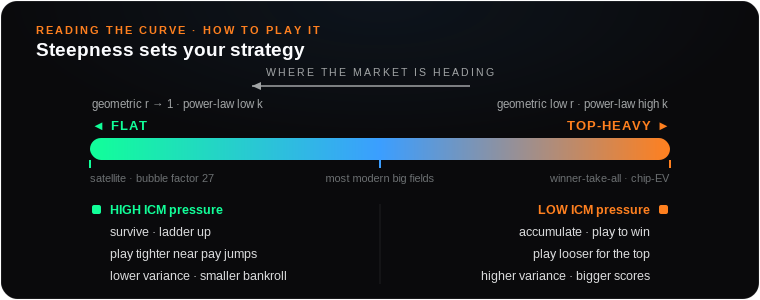
The practical read: the section of the curve you're sitting in is the section that governs you. Deep in the flat min-cash tail of a big event, chips are nearly chip-EV — just play poker. Climbing the steep final-table jumps of that same event, every elimination is real money — now survival matters. One tournament, two different games, depending on where the curve is steep.
It's also why final tables chop. When a table pauses to make an ICM deal or a "save," the players are hand-flattening a top-heavy curve — trading the marketing-driven peak nobody at the table wants for the survival value everyone feels. The steeper the official payout, the more likely the table quietly rewrites it. In other words, the flattening trend isn't being imposed on players; left to themselves, they flatten it anyway.
Where poker payouts are heading
Now a prediction, and I'll flag it as a prediction rather than dress it up as a fact.
Tere are plenty of loud voices for flatter payouts. One of them is Lee Jones — a poker-room veteran who has argued, in print, that it is long past time to flatten tournament payouts. His case isn't sentimental, it's economic: a recreational player who min-cashes gets the dopamine hit, pockets real money, and recirculates it into the next buy-in or the cash game. A single seven-figure winner wires the score off to a tax bill and it leaves the ecosystem for good. Flatter payouts keep more of the pool inside the poker economy — more Daves, playing more often. The 15%-of-field, 2× min-cash standard is that argument already poured into concrete.
But here's the tension that will decide how far it goes. Promoters resist flattening the top, because a headline first prize is a marketing line — "win a million" sells entries even when, in practice, almost nobody at the final table cares about the difference between a $10M and a $12M top prize. So the pressure runs two ways: player-and-economy pressure widening the tail, marketing pressure defending the peak.
My bet on the equilibrium, in payout-curve terms:
- Power-law with a floor and a cap becomes the universal big-field shape — it already effectively is — and the flattening trend simply pushes its knob: lower
k, a higher floor, more places paid. The trend doesn't replace power-law; it tunes it. - The result is a fattened tail, not a flat line. Expect a preserved marketing-friendly top, a fatter middle, and a raised floor — a capped, floored power-law, not a genuinely even split. The winner's-share cap is the contested frontier; the floor and the 15% marker have mostly already won.
- Online moves first, live lags. An online operator can retune a payout curve between two Sundays and A/B it against entry numbers; a live festival is bound by marketing decks printed months out. So watch the online rooms for the real experiments.
- Geometric stays where it belongs — small fields, sit-and-gos, home games — because nothing about the flattening trend changes the fact that a constant ratio can't pay a long tail. Dave's napkin is safe.
The honest caveat: the marketing incentive behind a giant first prize is sticky, and I could be wrong about how far the top ever gives. The safe version of the prediction is the narrow one — more places paid, higher floors, the top mostly intact — and everything past that is a question of how hard the recreational economy argument keeps pushing.
FAQ
Which payout structure should I use for my home game? Geometric, almost certainly. If you're paying three to a dozen spots, a geometric curve is simple and transparent — every prize is one multiplication off the last, so you can verify it without software (though pitbosser.com will do the math for you). Save the power law for when you're paying deep into a large field.
Why don't big tournaments just use a geometric curve too? Because it can't pay a long tail. A geometric curve steep enough to have a meaningful top drops below 1% of first prize by around 14th place, so there's nothing left to pay the 15th through 150th. Big events pay ~15% of the field, which is only possible with a power-law-style curve plus a min-cash floor.
Does a flatter payout mean I can gamble more? The opposite. Flatter payouts raise ICM pressure — laddering and min-cashing become more valuable than chips, so you should tighten up and prioritize survival near pay jumps. Top-heavy structures are the ones that reward loose, accumulate-and-win poker.
How do I tell at a glance how steep a payout sheet is? Look at first place's share of the pool — it's the fastest read there is. Roughly 40% or more to the winner is a top-heavy, play-to-win curve; a first prize in the mid-to-high 20s% is a flat, survival-friendly one; the low-to-mid 30s% is the middle ground most modern big fields sit in. You don't need the formula to know which game you're in.
What's a "normal" first-place share these days? Depends entirely on the curve's steepness, but the market is drifting down from the old top-heavy norms. Flatter modern structures spread more of the pool into the field; a min-cash of about 2× the buy-in has become the standard bottom of the ladder.
Is one structure "fairer" than the other? Neither is fairer — they reward different things. Top-heavy pays for winning and suits players with an edge who want their skill to show up in the top prize. Flat pays for surviving and suits recreational players and smaller bankrolls. Fair is picking the one that matches the room you're actually running.
Key takeaways
- Geometric drops by a constant percentage; power-law's drops shrink as you descend — that's the entire structural difference.
- At a final table the two are near-twins; at scale only power-law survives. A steep geometric curve is dead below 1% of first prize by ~14th place; power-law still pays a real min-cash at 100th.
- Small/private games → geometric (simple, few places). Big events → power-law plus a min-cash floor and a winner's-share cap.
- Flatter raises ICM pressure (play tighter, ladder up); top-heavy lowers it (accumulate, play to win). The steep section of the curve is the one that governs your decisions.
- The market is flattening — more places paid, ~2× min-cash floors — but marketing keeps the headline top-heavy, so expect a capped, floored power-law rather than a truly even split.
Back to Dave, still at the table, cash divided, pen down. None of what he did is exotic — it's two curves and the question of how many people you're paying, and his shoebox answered it correctly without ever naming the shape. But run either curve live, across a real field — solving the top prize, holding the floor, redrawing the whole table the moment a re-entry changes the count, then paying it all out cleanly — and the napkin becomes a spreadsheet, and the spreadsheet becomes a second job. Thats when propper tournament management software like Pitbosser kicks in. The point isn't the software, though; it's that once the arithmetic is automatic, you're free to pick the exact curve your room deserves — a simple geometric split for the home game, a floored power-law for the big one — and hand out prizes every player can check for themselves.
Two curves, one question: how many are you paying? Answer that, and the shape picks itself.
Sources: Lee Jones on flattening tournament payouts (poker.org); How payout structures differ across major series (The Hendon Mob); How payout structures impact ICM (GTO Wizard).
Pitbosser is poker tournament software for clubs and home leagues. The clock, the knockouts, the standings — handled.