Field-Weighted Poker Scoring Explained: The Formula Behind Modern POY Races
Field-weighted scoring: how modern poker leaderboards actually work.
The big idea in one sentence: instead of looking your points up on a fixed chart, field-weighted scoring calculates them from the size of the field you beat — rewarding you more for going deep in bigger, higher-stakes events and less for cashing in small ones.
If you've ever wondered why a runner-up in a mid-size event can out-score a min-cash in a giant one on a Player-of-the-Year leaderboard, this is the mechanism doing the work. Below is the exact formula the World Poker Tour's online arm (WPT Global) publishes, why it's shaped the way it is, four annotated graphics, and a set of worked examples, all landing on the same score, that you can check on a napkin.
Why leaderboards moved away from fixed points charts
For years, most series ranked players with a flat points table: finish 1st, get X points; finish 10th, get Y. Same numbers whether you beat 30 players or 3,000. It's simple, but it has an obvious flaw that many major franchises ran into repeatedly: it treats a small-field event exactly like a massive one, and it quietly turns into a volume contest. Whoever fires the most bullets wins, not whoever performs best.
The industry has spent two decades moving away from that. Modern ranking systems (the WSOP Player of the Year formula, the Global Poker Index, and WPT Global's leaderboard) all converged on the same principle:
Reward how deep you finished, adjusted for how hard the event actually was.
That adjustment is what "field-weighted" means. Buy-in and field size make an event worth more; your finishing position decides how big a slice you take; and a dampening function stops the biggest tournaments from swallowing the whole leaderboard. WPT Global is the one major operator that publishes its exact equation, so it's the cleanest one to learn from, and the model we'll use throughout.
The four ingredients
Every field-weighted score is built from four things about your tournament:
- Buy-in: how much it cost to enter (a proxy for the stakes and the strength of the field).
- Entrants: how many players you had to get through (the size of the field). Note that this counts entries, not unique players: in a re-entry event, every bullet fired counts toward the field size.
- Finishing position: where you placed (1st, 50th, 200th…).
- Top-6 bonus: a small multiplier if you reach the final stretch.
The formula
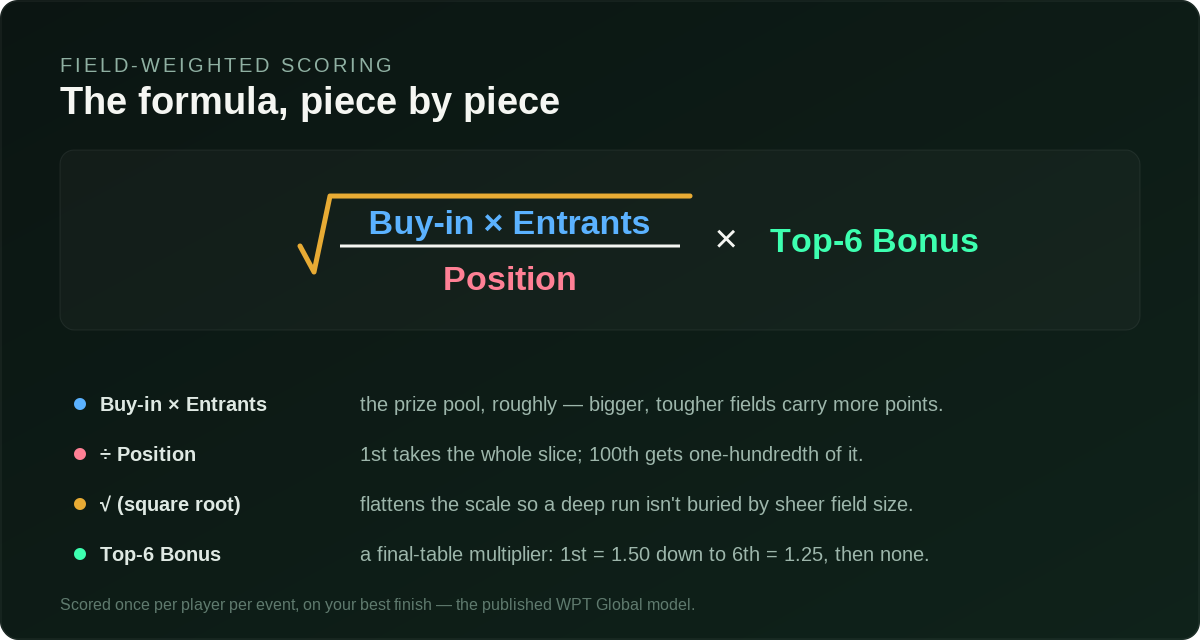
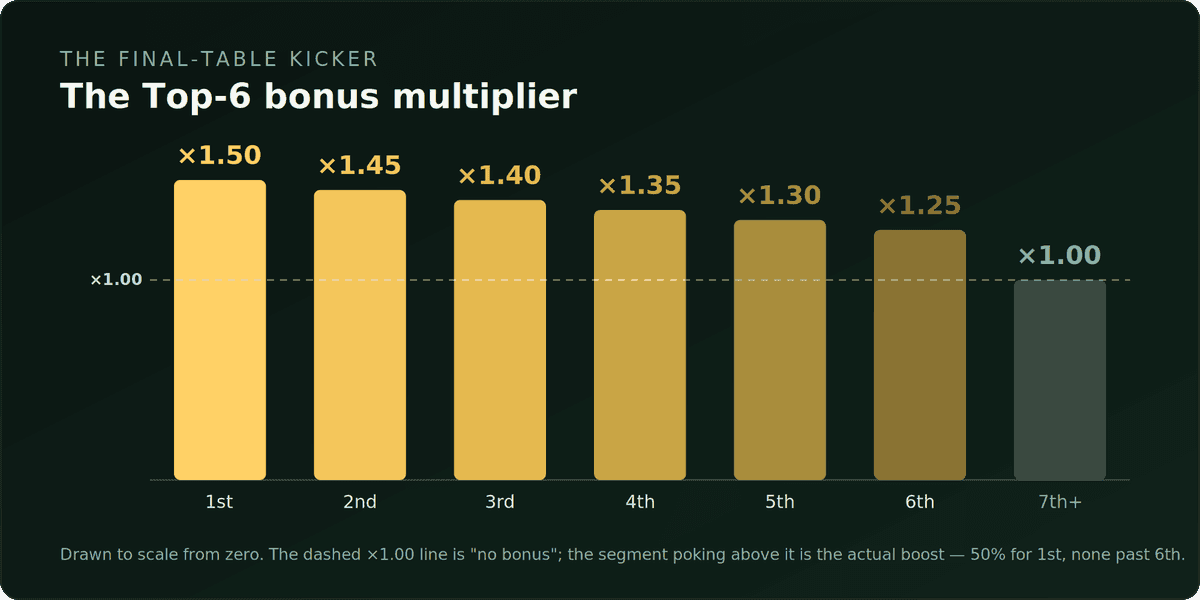
The Top-6 bonus multipliers are:
| Finish | Multiplier |
|---|---|
| 1st | ×1.50 |
| 2nd | ×1.45 |
| 3rd | ×1.40 |
| 4th | ×1.35 |
| 5th | ×1.30 |
| 6th | ×1.25 |
| 7th or worse | ×1.00 (no bonus) |
Why this shape? The intuition behind each piece
Buy-in × Entrants → this is essentially the prize pool (before rake). A bigger pool means a bigger, tougher tournament, which means more points are on the table.
÷ Position → finishing higher gives you a bigger slice. First place claims the whole thing; 100th place gets one-hundredth of it.
The square root (√) → this is the key innovation. Without it, a tournament that's 10× bigger would simply be worth 10× the points, and a min-cash in a mega-event would dwarf an outright title in a smaller one. The square root dampens the scale, so a deep run in a medium event can still compete with a min-cash in a huge one. It keeps the leaderboard honest.
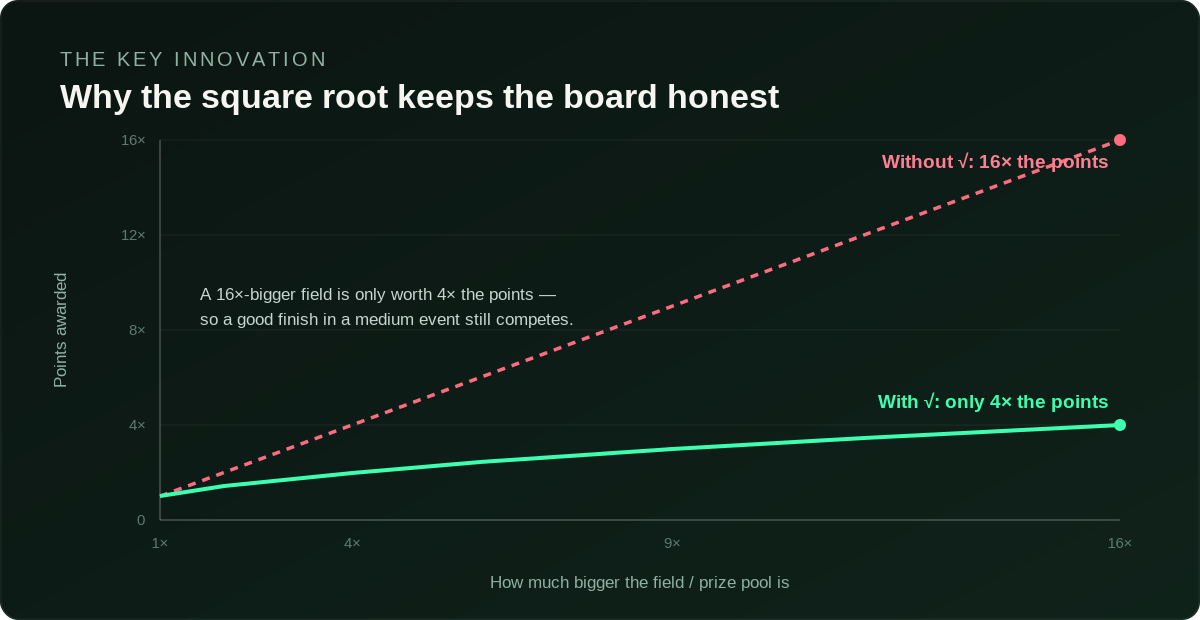
The chart above is the whole argument in one picture. Make the field 16× bigger and, without the square root, the points would be 16× bigger too. With the square root, they're only 4× bigger, enough to reward the tougher event but not enough to make small-field skill irrelevant.
Top-6 bonus → a final reward for the players who actually battled to the final table, layered on top of what the formula already gives them.
Three roads to the same score
Comparing three unrelated tournaments, with different buy-ins, fields, finishes, and point totals, makes you juggle everything at once. So flip it around instead: fix the reward at about 200 points, keep the exact same scoring system, and work backwards to ask what completely different results all earn that same score.
The rearrangement is simple. For a result to be worth 200 points:
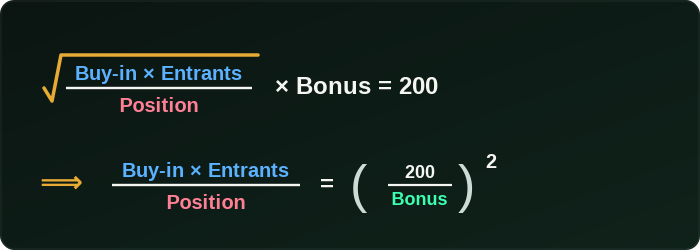
Rearranging the formula: for a result to be worth 200 points, the square root of (buy-in times entrants divided by position) times the bonus equals 200, which means buy-in times entrants divided by position equals (200 divided by bonus) squared.
Now here are three very different ways to satisfy it.
Road 1: Win a small local event
$200 buy-in · 90 players · 1st place (bonus ×1.50) √(200 × 90 ÷ 1) × 1.50 = √18,000 × 1.50 ≈ 134 × 1.50 ≈ 201 points
Road 2: Reach the final table of a mid-size event
$500 buy-in · 240 players · 5th place (bonus ×1.30) √(500 × 240 ÷ 5) × 1.30 = √24,000 × 1.30 ≈ 155 × 1.30 ≈ 201 points
Road 3: Make a deep run in a major
$1,000 buy-in · 1,200 players · 30th place (no bonus — outside the top 6) √(1,000 × 1,200 ÷ 30) × 1.00 = √40,000 × 1.00 = 200 points
Bar chart: winning a small event, final-tabling a mid-size event, and finishing top-2.5% of a major all score about 200 points, while merely min-cashing that same major scores only about 82.
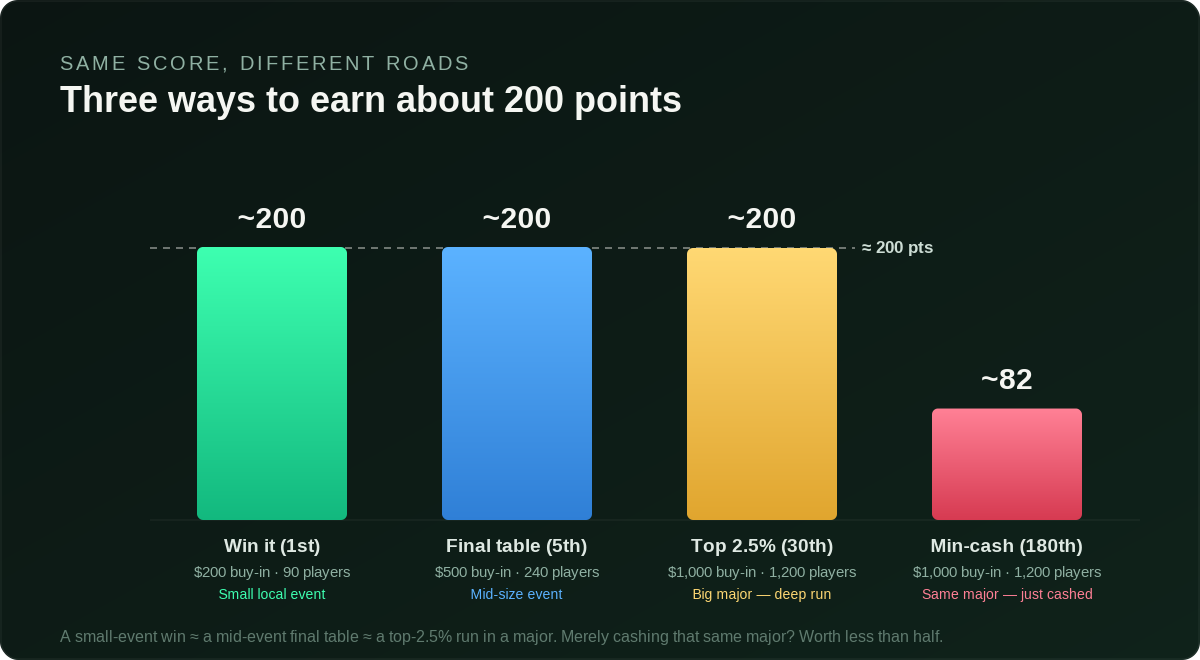
Three completely different nights at the felt: a trophy in a small game, a final table in a mid-size event, and a top-2.5% finish in a 1,200-runner major, and the system rates them as equals. That's worth sitting with: field-weighted scoring is telling you these achievements are worth the same, a claim a flat points chart could never make.
The revealing part: what doesn't reach 200
Watch what happens if, in that same 1,200-player major, you simply min-cash instead of running deep:
$1,000 buy-in · 1,200 players · 180th place (a typical min-cash, no bonus) √(1,000 × 1,200 ÷ 180) × 1.00 = √6,667 ≈ 82 points
Barely more than a third of the score you'd get for winning the little $200 event, and less than half of the deep run in the very same tournament. To match that small-event trophy, min-cashing the major isn't enough. You have to climb into roughly the top 2.5% of the field. That comparison sums up the whole approach: it pays for going deep, not for showing up to something big and squeaking into the money.
What this method rewards (and what it doesn't)
It rewards:
- Going deep, especially to the final table, where the Top-6 bonus stacks on top of an already-high score.
- Playing and beating bigger fields.
- Stepping up in stakes when you're ready.
It doesn't reward as much as you'd expect:
- Min-cashing huge tournaments: the square root flattens the payoff.
- Volume-grinding tiny events: a low buy-in plus a small field is a small score, even for a win.
There's one more rule that's easy to miss, and it changes strategy completely: on virtually every serious series (WPT, WPT Global, and WSOP alike) you score one result per player per event, on your best finish. Fire five bullets into the same tournament and only your deepest run counts. Re-entering doesn't pad your total; it just buys you more chances at a single, best-finish score. This is why modern leaderboards reward quality of runs over sheer quantity of entries.
How the big series compare
Field-weighting isn't one formula. It's a family. The inputs (buy-in, field size, position) are shared; the knobs differ.
- WPT Global publishes the exact equation above: square root of (buy-in × entrants ÷ position), times the Top-6 bonus. It's the only fully published one, which is why it's the best to learn from.
- WSOP Player of the Year uses the same logic but a different, unpublished curve: buy-in and field-size factors combined with a finishing multiplier that's roughly ×6 for a win, ×4 for a final table, and ×2 for any other cash. Only your top 15 results count in the 2026 race, another push toward deep runs over volume.
- The Global Poker Index (GPI) goes further, using logarithmic factors for both buy-in and finishing position, capping the very largest fields and buy-ins so no single result dominates. Same goal, heavier math.
The throughline across all three: move away from "who won the most money" and toward "who performed best, adjusted for how hard each event actually was."
Bringing field-weighted scoring to your own games
Here's the catch for anyone running a home game, a poker club, or a season-long series: this math is genuinely awkward to keep by hand. Every result needs the buy-in, the exact entry count, the finishing position, a square root, and the right bonus multiplier, and then it all has to be summed per player, ranked, and re-ranked every time a new game finishes. Do that across a full season and a spreadsheet turns into a second job. It's the kind of bookkeeping that quietly discourages clubs from running a proper leaderboard at all.
That's exactly the problem a dedicated tournament manager solves. A tool like Pitbosser runs the clock, tracks knockouts and finishing positions live, and does the standings math for you, so a field-weighted season leaderboard updates itself the moment a game ends and even broadcasts the live clock and standings to a TV in the room. The scoring model is configurable, so if your club prefers a flat points curve, a steep one, or the field-weighted approach described here, the app handles the arithmetic while you run the floor. The point isn't the software; it's that once the calculation is automated, a fair, transparent, field-weighted leaderboard stops being a chore and starts being something your players actually watch.
Frequently asked questions
What does "field-weighted" mean in poker? It means a player's leaderboard points depend on the size and stakes of the field they beat, not just their finishing position on a fixed chart. Bigger buy-ins and larger fields are worth more points.
What is the WPT Global points formula? Points = √(Buy-in × Entrants ÷ Position) × Top-6 Bonus, where the Top-6 bonus is 1.50 for 1st down to 1.25 for 6th, and 1.00 for 7th place or worse.
Why is there a square root in the formula? The square root dampens the effect of field size. Without it, a tournament 16× bigger would be worth 16× the points; with it, that event is worth only about 4× the points, enough to reward tougher fields without letting mega-events dominate the standings.
Do re-entries earn extra leaderboard points? No. On the major series you score one result per event, based on your best finish. Extra bullets give you more chances at a good result, but they don't stack points.
Is a min-cash in a huge tournament worth a lot of points? Less than most people expect. Because the square root flattens the scale and there's no bonus outside the top six, a deep run or a win in a smaller event often out-scores a min-cash in a much larger one.
Does field size count entries or unique players? Entries. A 1,000-entry event with 200 re-entries scores as a 1,000-entry field for everyone, matching how WSOP and WPT publish their numbers.
Key takeaways
- Field-weighted scoring calculates points from buy-in, field size, finishing position, and a final-table bonus, not a fixed chart.
- The formula is √(Buy-in × Entrants ÷ Position) × Top-6 Bonus.
- The square root is the linchpin: it lets a deep run in a medium event compete with a min-cash in a giant one.
- It rewards deep runs in tough fields, not volume-grinding small events or min-cashing huge ones.
- You score one best-finish result per event; re-entering doesn't pad your total.
- Running this fairly across a season is a math headache by hand, which is exactly what a tournament manager automates.
Different paths, similar rewards. That's a leaderboard worth playing for.
Pitbosser is poker tournament software for clubs and home leagues. The clock, the knockouts, the standings — handled.